

To understand IKEA’s consumer experience design, including store layout, product displays, navigation flows, and their influence on customer decision-making.
To study IKEA’s retail strategies such as product positioning, pricing, in-store communication, and service quality components.
To observe consumer behaviour in a live retail environment and relate classroom concepts—such as motivation, perception, and decision-making processes—through direct customer observation.
The industrial visit to IKEA Hyderabad provided a strong practical understanding of how consumer behaviour theories are implemented in a real retail environment. The visit helped me clearly observe how store layout, product displays, and guided navigation influence customer movement, time spent in store, and purchase decisions. I learned how IKEA’s retail strategies such as affordable pricing, flat-pack design, wide product assortment, and simple in-store communication create a strong value-for-money perception among customers. Through live observation, I could relate classroom concepts like motivation, perception, impulse buying, and decision-making processes with actual customer actions such as comparing alternatives, seeking information, family discussions, and unplanned purchases. Overall, the visit successfully bridged the gap between theory and practice and enhanced my understanding of experiential retailing and customer-centric strategy.

(Students and faculty with Mr. Rex after the briefing session )
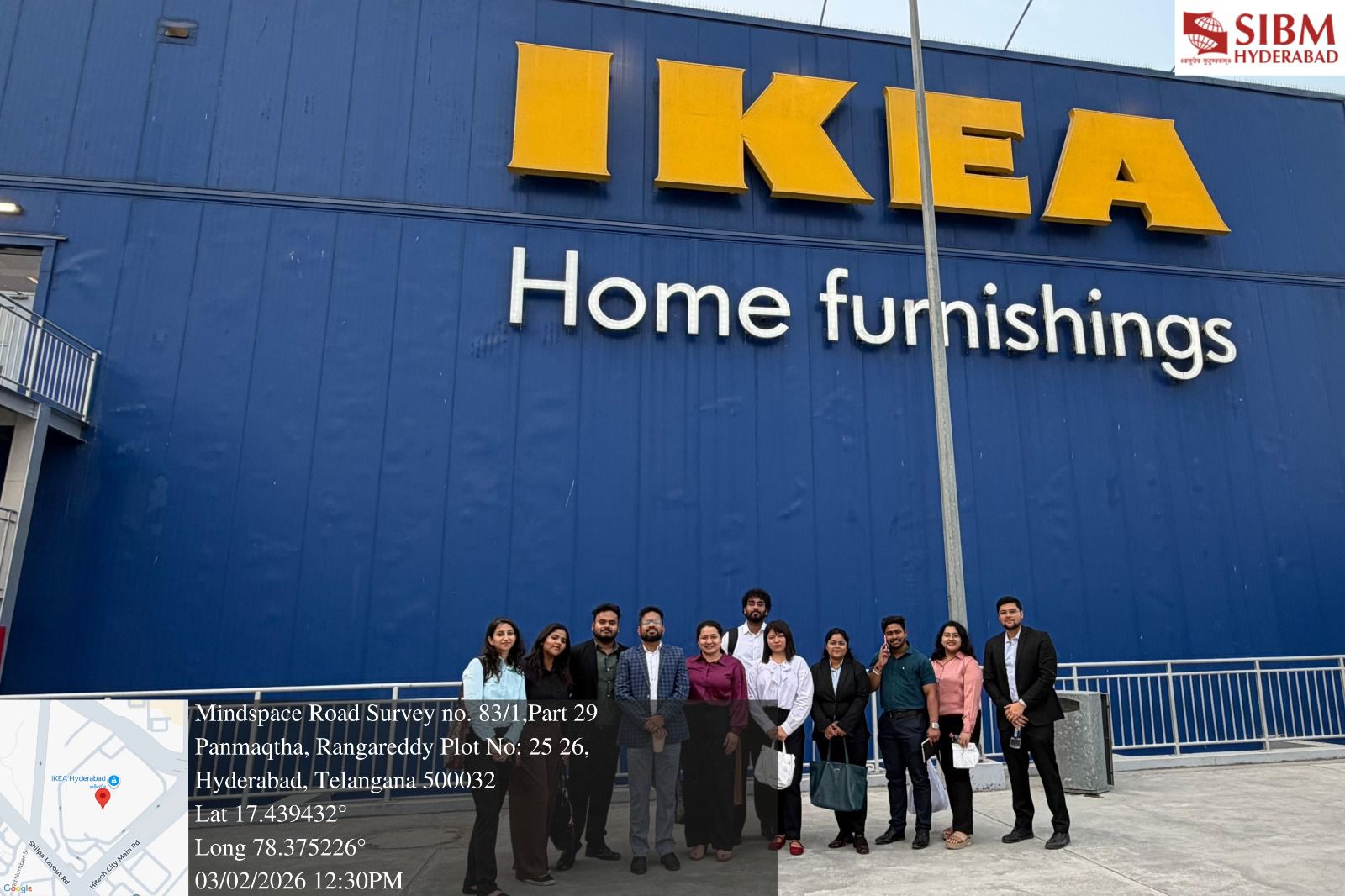
(Group photo outside IKEA store, Hyderabad )
The industrial visit to IKEA Hyderabad, with a scheduled departure time of 11:00 a.m., was conducted as part of a consumer behaviour field study. The visit included a meeting with Mr. Rex, Customer Relationship Officer, followed by a detailed briefing that provided insights into IKEA’s customer-centric approach. Additionally, the students and faculty interacted with Mr. Sajjal from the IKEA People and Culture team, which offered valuable understanding of the organisation’s work culture, employee engagement practices, and people-oriented values. Consumer behaviour focuses on understanding how individuals and groups select, purchase, use, and evaluate products and services to satisfy their needs and wants. In today’s competitive retail environment, companies must design experiences that go beyond product selling and focus on emotional, psychological, and functional satisfaction. The visit provided an opportunity to observe how a global retail brand applies consumer behaviour principles in a real-world setting. The store integrates layout planning, product display, pricing, communication, and service design in a way that subtly guides customer behaviour and influences purchasing decisions. This report presents a detailed analysis of these observations strictly based on the given objectives.
Direct observation of store environment and customer movement
Informal interaction with store representatives (Mr. Rex, Customer Relationship Officer or CRO)
Observation of shoppers’ behaviour at different sections of the store
IKEA Hyderabad follows a large-format, single-direction store layout. Customers move through a predetermined path that covers all major departments before reaching checkout.
Key characteristics:
One main entrance and exit
Clearly defined pathways
Department-wise zoning
Impact on Consumers: This layout minimizes the chances of customers missing any category and increases exposure to a wide variety of products. As customers walk through different room setups and product sections, new needs are triggered, leading to additional purchases.
Learning: The store layout acts as a silent salesperson that influences browsing behaviour and increases basket size.
Products are displayed in complete room settings rather than as individual items. For example, a bedroom setup includes bed, mattress, wardrobe, lighting, rug, and décor accessories.
Impact on Consumers:
Helps customers visualize usage
Reduces imagination effort
Encourages bundle buying
Learning: Customers find it easier to decide when they can see how products fit into real-life situations.
Navigation inside the store is supported by
Impact on Consumers: Customers feel in control of their shopping journey. Confusion and stress are reduced, which improves satisfaction.
IKEA’s experience design influences decisions in multiple ways:
Visual exposure builds desire
Clear information reduces risk
Step-by-step journey reduces overload
Conclusion for Objective 1:
IKEA’s consumer experience design strategically guides customers from inspiration to purchase, making decision-making easier and more enjoyable.
IKEA positions itself as a provider of:
modern and simple design,
functional home solutions,
affordable pricing.
Products are designed using cost-efficient materials and flat-pack packaging, which lowers manufacturing and logistics costs.
Learning:
IKEA is positioned as a value-for-money brand
rather than a luxury furniture brand.
IKEA follows a low-to-mid pricing approach with transparent pricing.
Learning
Customers perceive IKEA as honest and reasonably priced, which increases trust.
Communication inside the store includes:
The communication focuses on informing rather than hard selling.
Service Quality Components IKEA offers:
Learning:
Service design supports both independent shoppers and those who need guidance.
IKEA combines product, price, place, promotion, and service into a unified system that focuses on long-term customer relationships rather than only short-term sales.
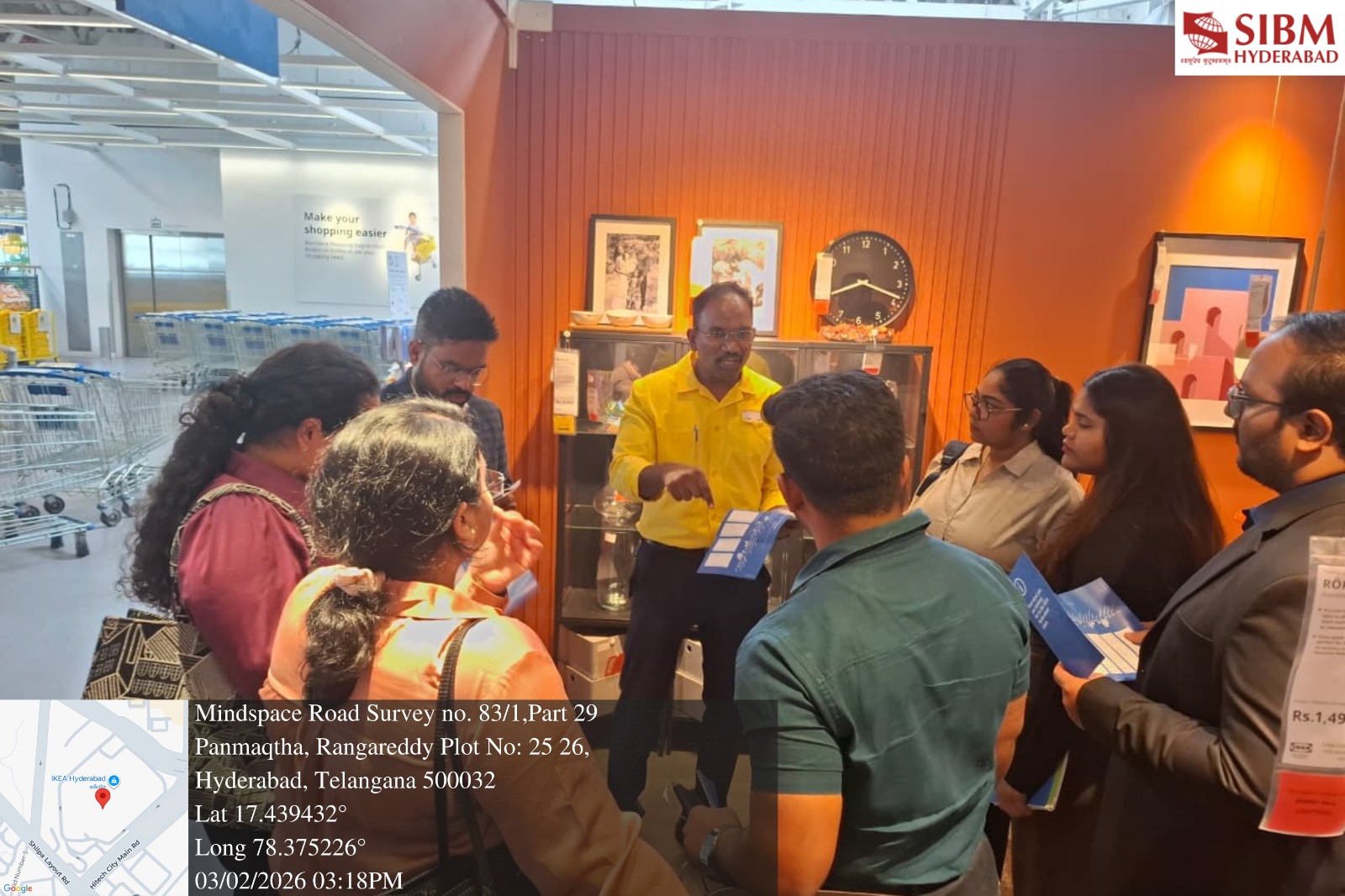
(Mr. Rex explaining IKEA’s retail strategy )
Observed motives include
Both functional and emotional motivations were present.
Customers perceive IKEA as modern, reliable, and affordable. Store cleanliness, lighting, and organization strongly influence this perception.
Store cleanliness, lighting, and organization strongly influence this perception.
Observed stages:
Impulse buying was commonly observed.
Many customers shopped in groups or families. Decisions were discussed before final selection, showing strong reference group influence.
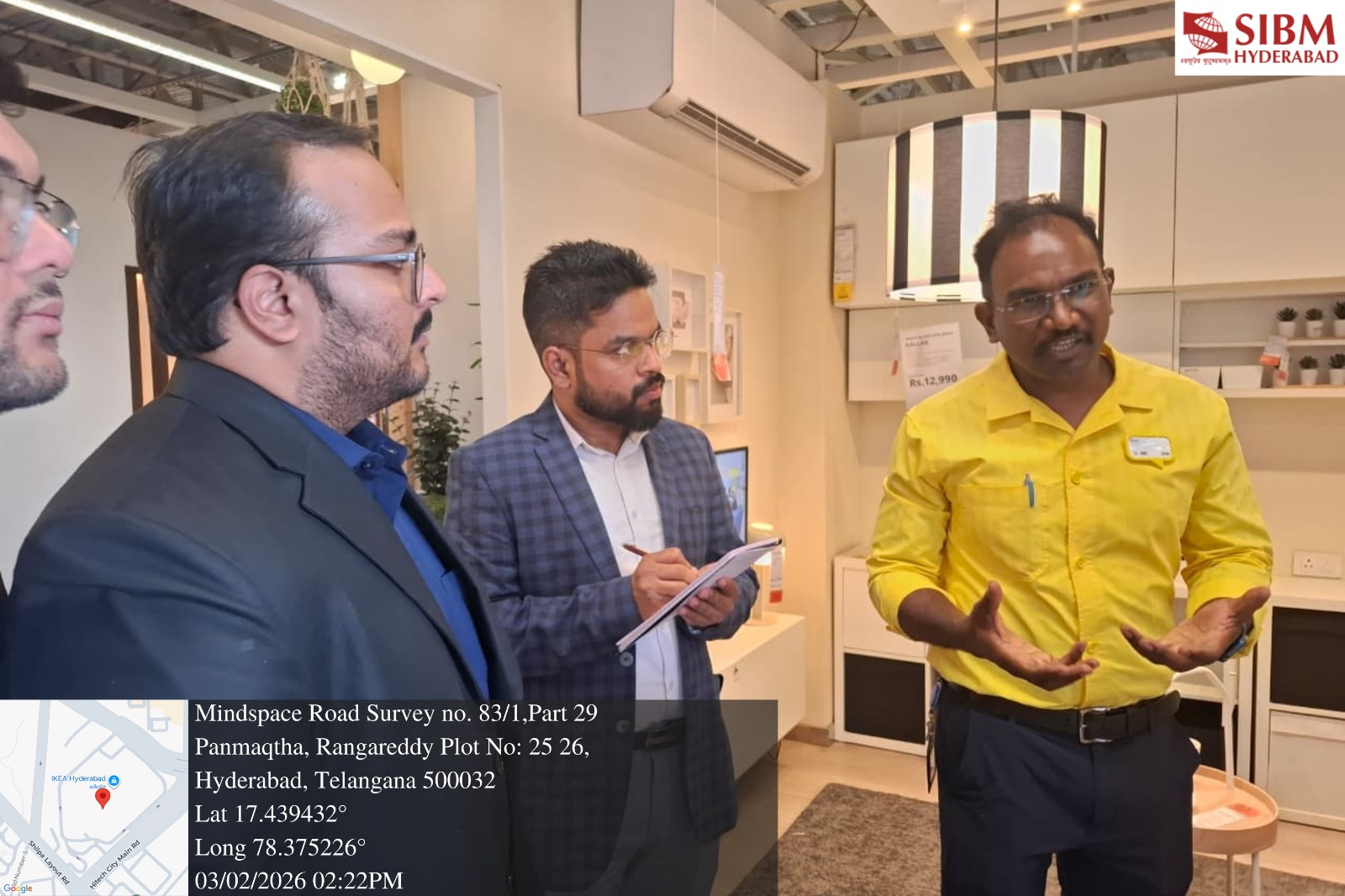
(Connecting classroom learning with IKEA operations )
The industrial visit to IKEA Hyderabad provided a clear understanding of how consumer experience design, retail strategies, and behavioural concepts work together in a real-world setting. IKEA successfully integrates store layout, product display, pricing, and service quality to influence customer decisions. The visit helped connect classroom theories with practical observation, making the learning experience highly valuable for an MBA student specializing in Consumer Behaviour.


